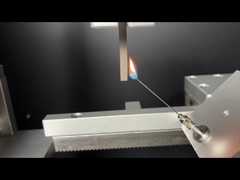
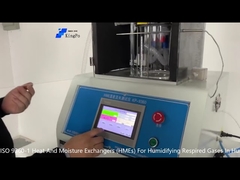
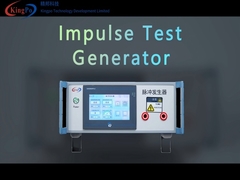
Brief: In this video, we demonstrate the KP-1240S High Voltage Current Carrying Test System in action, showing you how it generates high-intensity defibrillation pulse currents for testing implantable cardiac device connectors. You'll see the practical steps for setting up and running compliance tests according to ISO 27186:2020, including waveform generation and safety procedures, so you can judge its suitability for your medical device testing needs.
Related Product Features:
Generates high-voltage pulses up to 1.53 kV peak voltage and ≥50 A current peak for defibrillation simulation.
Produces monophasic truncated exponential waveforms with adjustable duration from 10-20 ms and fast rise time <10 µs.
Compliant with ISO 27186:2020 Annex E for testing four-pole connector systems (IS-4/DF-4) in cardiac devices.
Features built-in resistive load simulation (50-100 Ω) to mimic patient impedance during external defibrillation.
Includes automatic polarity switching and pre-programmed sequences for multiple shock protocols (5-10 pulses).
Offers high-precision measurement with voltage ±1%, current ±2%, and time ±0.5% accuracy.
Provides comprehensive safety features including overload protection, emergency stop, and automatic discharge.
Supports data recording with built-in waveform capture and storage for test report generation.
FAQs:
What international standard does the KP-1240S comply with for defibrillation pulse testing?
The KP-1240S is fully compliant with ISO 27186:2020 Annex E for high-voltage pulse testing of four-pole connectors in active implantable medical devices, while maintaining backward compatibility with YY/T 0972-2016.
What type of waveform does the system generate for defibrillation simulation?
It produces a monophasic truncated exponential waveform that accurately simulates external defibrillator shocks, with configurable parameters including 1.53 kV peak voltage, ≥50 A current peak, and 18 ms default pulse duration.
Is the KP-1240S suitable for testing both IS-4 and DF-4 connector systems?
Yes, the system supports testing for both low-voltage (IS-4) and high-voltage (DF-4) four-pole connector systems as defined in the ISO 27186:2020 standard for implantable cardiac rhythm management devices.
What safety features are incorporated into the test system?
The system includes multiple safety mechanisms such as overload protection, short-circuit protection, emergency stop function, automatic residual energy discharge after each pulse, and >10 kV isolation between output and control circuits.
How does the KP-1240S help with regulatory approvals for medical devices?
It provides traceable, repeatable test results required for regulatory submissions to authorities like FDA and for CE marking, helping manufacturers meet global registration requirements for implantable cardiac devices.